
How Long Does SEO Take to Work? A Realistic Timeline
Published 2026-04-08
"How long until we rank?" is the first question almost every business owner asks before signing off on SEO, and it deserves a straight answer instead of a vague "it depends." The honest version is this: SEO is not one timeline, it is several timelines running at different speeds, and understanding which parts move fast and which parts compound slowly changes how you should evaluate progress in month one, month three, and month six.
Why SEO Timelines Get Misunderstood
Most of the confusion around SEO timelines comes from treating search engine optimization as a single event instead of a layered process. A technical fix like resolving a broken canonical tag can influence indexing within days. A content strategy built around topical authority can take months to fully mature, because Google needs to see consistent signals of expertise and relevance before it trusts a site enough to rank it for competitive terms.
The businesses that get frustrated with SEO are usually the ones expecting a single-tactic timeline to apply to the entire strategy. The businesses that see the best long-term results are the ones who understand that different keyword types, content types, and technical fixes each have their own maturation curve.
The 30 Day Window: What Actually Moves Fast
In the first 30 days, expect technical and structural wins, not ranking wins. This is when broken pages get fixed, duplicate content gets resolved, page speed improves, and schema markup gets implemented. None of that shows up as a ranking jump immediately, but it removes the barriers that were preventing rankings from happening at all.
Long-tail keywords, meaning specific, lower-competition search phrases with three or more words, can sometimes see early movement in this window if the page targeting them is well-optimized and the site has at least baseline authority. A phrase like "emergency plumber Boston flooded basement" has far less competition than "plumber," and a well-built page can start appearing for it faster than most people expect.
The 90 Day Window: Where Momentum Builds
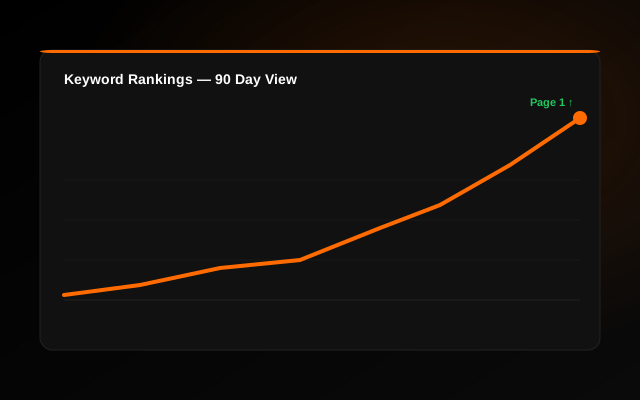
By day 90, Google has typically re-crawled and re-indexed most of the site's updated pages, and early content has had time to earn some initial trust signals. This is usually when businesses start to see movement on page two and three keywords shifting toward page one, and when long-tail traffic starts becoming a measurable, if modest, source of leads.
This is also the point where a lot of SEO campaigns get abandoned prematurely, right before the compounding effect starts to show up in the data. Ninety days is enough time to validate the strategy is working technically, but it is rarely enough time to judge the full revenue impact.
The 6 to 12 Month Window: Where the Real Growth Happens
Head terms, meaning short, high-competition keywords like "roofing company" or "personal injury lawyer," typically take six months or longer to move meaningfully, especially in markets with established competitors who have years of backlinks and content depth. This is not a flaw in the strategy; it reflects how much competitive signal Google needs to see before it re-ranks an authority position that took competitors years to build.
This is also the window where topical authority compounds. A site that has published consistent, semantically deep content around a subject for six months looks fundamentally different to Google than a site that published five pages and stopped. Rankings in this window are less about any single page and more about the accumulated trust of the domain.
How to Judge Progress Before Rankings Fully Mature
Rankings are a lagging indicator. Before rankings move, you should be able to see leading indicators: improved crawl stats in Search Console, increased impressions even if click-through hasn't caught up yet, new keywords beginning to appear in the 20 to 50 position range, and technical health scores improving. An SEO partner who cannot show you these leading indicators in month one or two is not giving you enough visibility into whether the strategy is actually working.
Frequently Asked Questions
Technical fixes and long-tail keyword pages can show early movement within 30 days, but competitive head-term rankings typically take much longer. Thirty days is enough time to validate that the technical foundation is sound, not enough time to judge full ranking or revenue impact.
Keyword difficulty is driven by how many established, authoritative competitors are already targeting that exact phrase. Long-tail, specific phrases have less competition and can rank faster, while short, high-volume head terms require more accumulated domain authority and typically take six months or more.
Yes. A brand new domain has no historical trust signals, so Google is naturally more cautious about ranking it for competitive terms until it accumulates a track record of consistent, relevant content and legitimate backlinks.
Unresolved technical issues are the most common cause of delayed results, things like duplicate content, broken canonical tags, slow page speed, or missing schema markup. These issues can prevent even excellent content from being fully indexed or trusted.
Generally no, unless the leading indicators (crawl stats, impressions, early keyword movement) are also flat. If those indicators are trending up but rankings haven't fully matured, the strategy is usually working as expected and needs more time to compound.
Ready to Put This Into Practice?
Get a free audit and we'll show you exactly where your site stands.